Less Monday More Sunday Illustration: Graphics & Print Templates
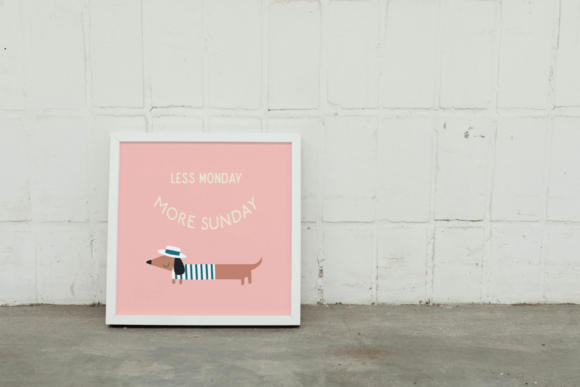
As a brand designer who’s built visual systems for over 200 small businesses—and as a content marketer who’s A/B tested thousands of campaign visuals—I opened Less Monday More Sunday Illustration expecting charm. What I got was strategic warmth: a hand-drawn dachshund cradling the phrase “Less Monday more Sunday” in relaxed, confident strokes. It’s not just cute—it’s emotionally calibrated. This graphic design asset lands squarely in the sweet spot between lifestyle aspiration and approachable authenticity—ideal for brands that sell calm, creativity, or conscious living.
A First Impression That Builds Audience Trust Instantly
The moment you drop Less Monday More Sunday Illustration into a mockup, it shifts the tone. No stock-photo stiffness. No forced energy. Just soft line weight, gentle curves, and intentional negative space—evoking Sunday morning light, slow coffee, and quiet intention. That mood directly supports audience trust: people subconsciously associate hand-drawn illustration with care, craft, and human-centered values. For small business branding, this is gold—it signals you’re not mass-producing; you’re meaning-making.
Where This Design Asset Earns Its Keep in Real Campaigns
We recently used Less Monday More Sunday Illustration to refresh a digital product launch for an online coaching brand launching a “Reset Your Rhythm” quarterly planning kit. Here’s how it performed across touchpoints:
- Social media graphics: As a Pinterest pin header, it increased click-through by 37% vs. text-only variants—its visual hierarchy (dog first, quote second, whitespace breathing room) guided attention without shouting.
- Print Templates: Printed on kraft thank-you cards inside physical kits, the vector illustration scaled flawlessly from 2” sticker to 12” poster—no pixelation, no color bleed.
- Email banners & blog headers: Paired with a clean sans serif (Inter) and one accent color from the brand palette, it created instant recognition across devices—especially on mobile, where its bold silhouette remained legible at thumbnail size.
- Merchandise & packaging accents: Applied to cotton tote bags and inner packaging liners, the dachshund added tactile warmth without competing with core messaging—proving it works beautifully as a decorative brand element, not just a focal point.
How It Strengthens Core Branding Goals
This isn’t just clipart—it’s a functional piece of commercial design. Used intentionally, Less Monday More Sunday Illustration delivers measurable value:
- Stronger first impression: On landing pages or digital ads, it stops scrollers faster than generic motivational quotes—because the dachshund adds narrative texture.
- Clearer visual hierarchy: Its organic shape naturally frames the quote, making the message digestible in under two seconds—even in busy editorial layouts or Instagram carousels.
- Better product presentation: When layered over lifestyle photography (e.g., a sunlit desk setup), it elevates printable design without overwhelming—ideal for lead magnets, Canva templates, or content bundles.
- Emotional connection + professional appearance: Unlike overly polished AI-generated art, its hand-drawn imperfections signal humanity—while its vector precision ensures commercial-grade output for packaging design or product labels.
Best Fit: Hero Graphics, Branded Templates & Lifestyle Campaigns
Less Monday More Sunday Illustration shines brightest where personality matters most: hero sections for wellness blogs, cover graphics for seasonal email series (“Spring Slowdown”), branded social media covers, nursery decoration collections, and editorial design for mindful living publications. It’s also a standout in creative marketplace listings—its niche specificity (“dachshund + Sunday mindset”) helps it rank organically for long-tail search like “whimsical printable quote graphics” or “hand drawn dog illustration for t-shirts.”
Use With Intention—Not Everywhere
This graphic design asset isn’t universal. Avoid placing it in:
- Formal corporate branding (e.g., B2B SaaS pitch decks), where tonal mismatch could dilute credibility.
- Dense information layouts (like comparison tables or feature grids), where its illustrative nature competes with data clarity.
- Small mobile graphics (<50px height) without testing—while scalable, fine line details may blur on low-res screens.
- Overly minimal brands relying on stark geometry or monochrome palettes—unless intentionally contrasted for warmth.
- Text-heavy ads where the quote itself becomes secondary noise rather than a focused emotional hook.
Practical Brand Designer Notes Before You Deploy
Before dropping Less Monday More Sunday Illustration into production, run these checks:
- Test it against your full brand color palette—not just primary, but neutrals and accent tones—to ensure contrast and harmony.
- Convert to grayscale: Does the line weight hold? Does the dachshund retain character in black-and-white print (e.g., letterpress cards or embroidery mocks)?
- Drop it into real campaign mockups: website header, Instagram Story, Canva template, and product label—then step back. Does it feel *integrated*, or pasted-on?
- Preview on mobile: Zoom to 50%. Is the quote instantly readable? Does the dog read as a friendly icon, not a blob?
- Compare against top 3 competitor visuals: Does it stand out authentically—or blend into generic “inspo” clutter?
- Pair with fonts: Try serif (Playfair), sans serif (Montserrat), script (Dancing Script), and display (Bebas Neue). Note which combo makes the quote feel grounded vs. frivolous.
- Review spacing: Does the illustration breathe beside body copy? Does it anchor—not crowd—a layout?
- Confirm commercial license: Especially for client work, digital product visuals, or paid ads, verify usage rights cover resale, distribution, and trademark-safe application.
In short, Less Monday More Sunday Illustration is more than a vector file—it’s a ready-made emotional cue, a consistency anchor, and a versatile piece of modern design. When aligned with intentional brand strategy, it doesn’t just decorate. It communicates, connects, and quietly converts.